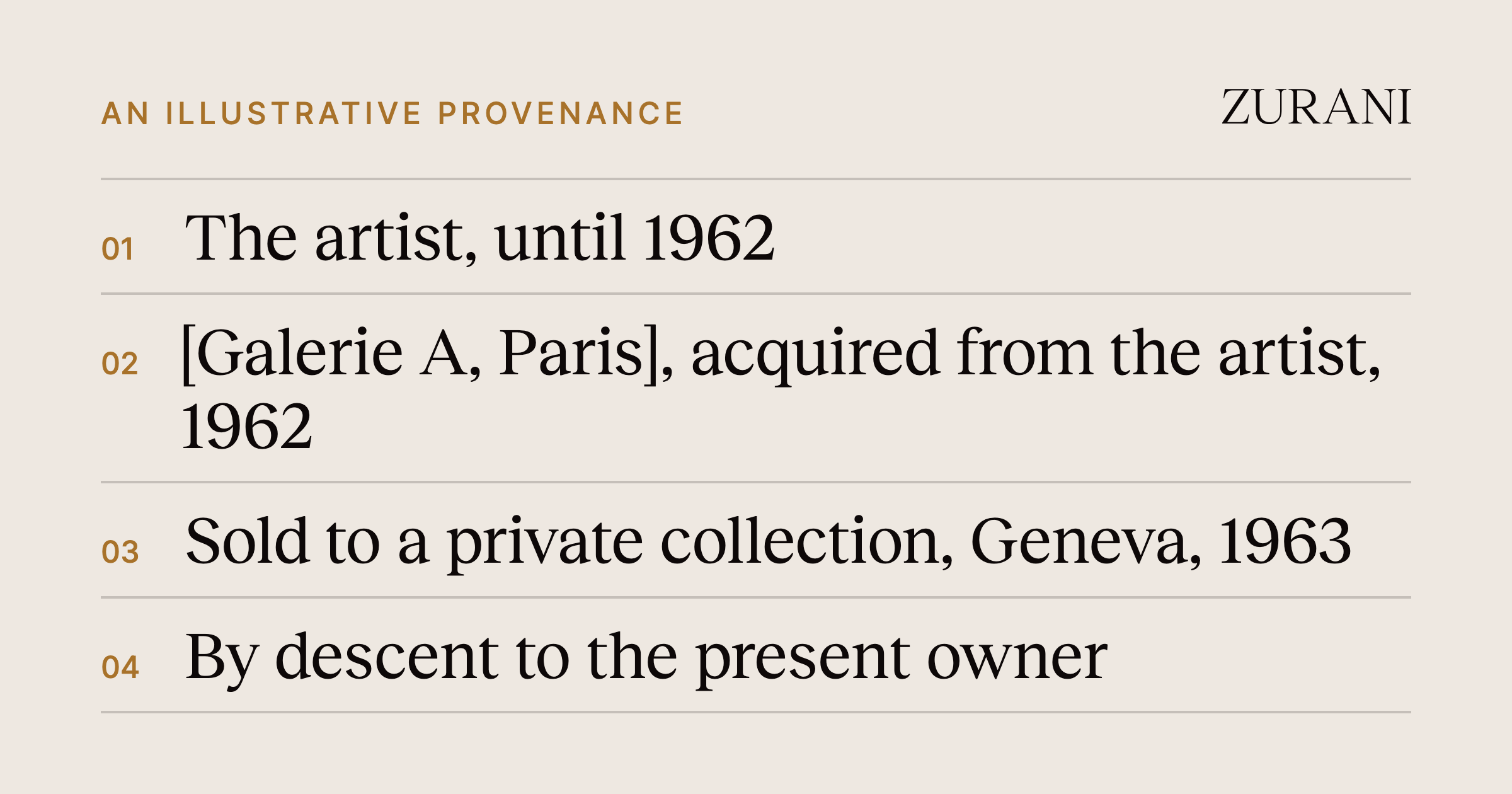
Illustrative example only; no real artwork or collection is described.
Updated 21 October 2026
Provenance is the documented history of a work of art: who has owned it, who has held it, and where it has been, from the artist’s studio to the present day. The Museum of Fine Arts, Boston defines it as “the history of ownership, from the time of its creation to the present.” For a collector the definition matters less than what sits behind it. A provenance is a set of claims about the past, and each claim is only as good as the evidence for it.
That is why it matters. A work whose history is documented can be researched, insured, lent, valued and sold with fewer unanswered questions. A work whose history is asserted but not evidenced carries those questions with it, and they surface at the worst moments: at a sale, at an insurance claim, at a museum loan, or when an estate is being settled.
What provenance is, and what it is not
Provenance is the ownership and custody history of a specific object, supported by documents. It is not a judgement about who made the work (that is attribution), not a conclusion that the work is genuine (authenticity), not a legal finding that the seller owns it (title), not a description of its physical state (condition), and not an opinion of its worth (valuation). A good provenance supports each of those questions. It answers none of them by itself.
What should a provenance record contain?
A usable provenance is a chronological list of owners and custodians, with a date, a place and a method of transfer for each entry, and a document behind each line. The main elements are:
- the owner or collection, private or institutional, and where it was based;
- the dates it entered and left that ownership, and how it moved on: sold, given, bequeathed, inherited, consigned, exchanged;
- the dealer, gallery, auction house or agent involved, with the sale reference where one exists;
- the exhibition history: where the work was shown, when, and its catalogue number;
- the literature: publications in which the work is described or illustrated;
- the physical traces on the object: labels, stamps, inventory numbers and inscriptions on the reverse, the stretcher or the frame;
- the archival references that support any of the above.
Condition and conservation reports sit alongside the provenance rather than inside it, and a treatment report from a known date can corroborate where a work was and who was responsible for it at the time.
How do you read a provenance entry?
Museums and catalogues raisonnés write provenance in a compressed form, and each uses a stated convention. In the convention common to many American museums, set out by the Krannert Art Museum following the American Alliance of Museums’ provenance guide, entries run in chronological order from the earliest known owner; life dates appear in brackets; a semicolon indicates that the work passed directly from one owner to the next, while a full stop indicates that a direct transfer did not occur or is not known to have occurred; and uncertain information is flagged with “possibly” or “probably” and explained in a note. Under the same convention, dealers and auction houses are placed in square brackets to distinguish them from private owners. Other institutions and catalogues use their own keys, so a provenance should be read against the convention its author states.
Here is an illustrative provenance. It is invented for this article and does not describe any real work, gallery or collection.
The artist, until 1962; [Galerie A, Paris], acquired from the artist, 1962; sold to a private collection, Geneva, 1963; by descent to the present owner.
Exhibited: Galerie A, Paris, 1962, no. 14.
Literature: catalogue raisonné, 1975, no. 212, illustrated.
Read line by line, this says more, and less, than it first appears to.
“The artist, until 1962; [Galerie A, Paris], acquired from the artist” tells you a dealer took the work from the studio. If the gallery’s stock book or a 1962 invoice exists, the first transfer is evidenced; if not, the line is a claim. In this convention the brackets signal a commercial intermediary, and a dealer may have owned the work or held it on consignment. The Philadelphia Museum of Art notes that the word “with” is used precisely because a dealer may have held a work without owning it.
“sold to a private collection, Geneva, 1963” is the line most often accepted on trust. “Private collection” can be a courtesy to a living owner who prefers not to be named, or the point at which the trail goes cold. Under this convention the semicolon claims a direct transfer from the gallery; ask what evidences it. The same applies to “acquired from the above”, which asserts that the seller in one line bought from the owner in the previous line and proves nothing unless the transaction is documented.
“by descent to the present owner” means the work passed within a family, usually by inheritance; the Roy Lichtenstein catalogue raisonné uses the phrase for transfers within families that are not fully documented. It is a normal entry. It also means the chain runs through a family, so the supporting evidence is usually a will, probate or succession records, an estate inventory, family papers or other contemporaneous documents, and the entry is only as strong as whichever of those can be produced.
The exhibition and literature lines are the strongest external corroboration a provenance can have, because a catalogue printed in 1962 is hard to fabricate after the event and a catalogue raisonné entry places the work in the scholarly record. Neither proves who owned the work at any given moment. Each shows that a specific object, matching this description, existed and was seen.
What counts as evidence?
Provenance research is documentary. The Responsible Art Market Initiative’s due-diligence toolkit puts the standard plainly: a provenance should be supported and verified wherever possible with factual, written or photographic evidence, and any part that is hypothetical or cannot be verified should be indicated clearly. The table shows what common types of evidence tend to establish, and what they do not.
| Evidence | What it may show | What it does not prove on its own |
|---|---|---|
| Auction catalogue entry and price record | That a work matching the description was offered and, if a price is recorded, sold on a stated date | Who the buyer was; that the work offered is this object rather than a version |
| Gallery invoice or stock-book entry | A sale, its date, the parties and the price | That the gallery owned the work rather than holding it on consignment; clear title |
| Exhibition catalogue and loan records | That the object was shown at a named venue on a stated date, usually with an owner credit | Ownership beyond what the credit line states |
| Catalogue raisonné entry | That the work is recorded in the scholarly record for the artist, with the provenance known to the compiler | Authenticity beyond the compiler’s own terms; completeness of the ownership history; title |
| Labels, stamps and inventory numbers on the reverse | A physical link to a gallery, exhibition, collection or shipper at a point in time | That the label belongs to this work originally; labels can be moved |
| Estate, foundation or artist confirmation | That the work is known to, or accepted by, the body concerned | Legal title; condition; value |
| Correspondence, photographs and family papers | That the work was in a stated place at a stated time | The terms on which it was held |
| Shipping, customs and export documents | Movement between jurisdictions on a stated date, and who consigned it | Ownership; that export was lawful unless the licence itself says so |
| Insurance schedules and valuations | That an owner insured or valued the work on a stated date | Title; authenticity |
| Loss-register search certificate | That the work was not, on the date of search, recorded in the databases searched | That the work has never been stolen or claimed; the Art Loss Register itself states that no database of stolen art can be complete |
Two habits follow. Match every entry to a document, and where none exists, write that down. And look at the object as well as the paper: the North Carolina Museum of Art lists labels and markings on the reverse among the primary sources for provenance research, and a verso photograph belongs in every collector’s file.
What do gaps in provenance mean?
Gaps are normal. The Museum of Fine Arts, Boston says so in terms, and the North Carolina Museum of Art explains why: documents are destroyed, records have not yet been found, and works changed hands for centuries without anything being written down. Private ownership, inheritance, discretion, the closure of a gallery, war and displacement all break chains. A gap is not evidence of a problem. An unexplained gap is a question not yet answered, and the right response is proportionate research, not assumption in either direction.
Some periods carry more weight. For works that were, or could have been, in continental Europe between 1933 and 1945, American Alliance of Museums standards ask for serious research into incomplete or uncertain provenance while giving reasonable consideration to gaps in light of the passage of time and the circumstances of the era. The Washington Conference Principles of December 1998, endorsed by 44 states, ask the same. For antiquities and archaeological material the relevant date is often 1970, when the UNESCO Convention on the illicit import, export and transfer of ownership of cultural property was adopted, and a provenance that cannot place an object outside its source country before then needs specialist attention. The site’s article on art restitution covers how those claims are changing.
For every gap, ask what period it covers, what jurisdictions the work may have been in, and whether the work belongs to a category where the gap engages a recognised research standard. Where it does, commission the research before purchase and record the result whichever way it falls.
How is provenance verified, and by whom?
Verification is the work of matching claims to sources, and no single party can do all of it. The sequence that tends to work is this.
- Obtain the seller’s provenance in writing, with the documents the seller holds. Treat it as the starting hypothesis.
- Examine the object: signatures, inscriptions, labels, stamps and inventory numbers on the reverse, photographed and compared with the written provenance.
- Test each entry against an independent source: auction price databases and archived sale catalogues; gallery archives or the gallery’s successor; exhibition catalogues and institutional loan files; the published literature.
- Consult the recognised authority for the artist where one exists: the catalogue raisonné, the estate or the foundation. That is the catalogue raisonné question, treated separately on this site. A catalogue entry records what the compiler knew, and the Lichtenstein catalogue, like most, states that inclusion is not a warranty of authenticity or provenance.
- Search the loss and claims databases. The Art Loss Register holds over 700,000 items and searches external databases for the 1933 to 1945 period; its own guidance is that a certificate demonstrates due diligence but does not excuse asking the owner for further evidence.
- Where the gap or the period calls for it, commission a provenance researcher; where title is in doubt, take the documents to a lawyer.
Each step belongs to a different party: galleries and auction houses hold transaction records, museums hold loan files, estates and catalogue authors hold the scholarly record, and a conservator, a provenance researcher, an appraiser and a lawyer each read the file for a different question. An adviser’s role is to assemble the file, see where it is thin, and know which specialist the thin part belongs to. That is documentary work, not a legal determination of ownership, and it should never be described as one.
Provenance, authenticity, attribution, title, condition and valuation
These are separate questions, answered by different people with different evidence. Provenance is the documented history of ownership and custody. Authenticity is whether the work is genuinely by the stated artist; the Responsible Art Market toolkit recommends gathering expert opinion, provenance research and scientific evidence rather than relying on any one. Attribution is the scholarly judgement assigning authorship, which can change as scholarship changes. Title is the legal right to own and transfer the work, and a complete-looking provenance is not proof of it: a work can have a full ownership history and still be subject to a claim. Condition is the physical state of the object, established by examination. Valuation is an opinion of value for a stated purpose on a stated date. A catalogue raisonné is a scholarly reference to an artist’s body of work; it is not a title register and not automatically a complete provenance.
Why provenance matters for valuation, insurance and resale
Documentation informs valuation, insurability and marketability, within limits. An appraiser preparing a valuation reads the provenance for what it supports: attribution, exhibition history, literature and, through the auction entries, price history. A well-documented work is easier to compare and easier to defend, and the same file is what an insurer asks for at underwriting and again at a claim. At resale, a seller who can answer the questions keeps the negotiation on the work.
The limit is that provenance supports value; it does not create it. A perfect ownership history for a minor work makes it a well-documented minor work. And where parts of a provenance cannot be evidenced, that uncertainty becomes part of the buyer’s due-diligence decision and part of the basis of any valuation prepared for a stated purpose. Zurani’s judgement is that the documentary file is the cheapest part of a collection to get right and the most expensive to reconstruct afterwards.
How should collectors keep provenance records?
For a collector, and especially for a family office holding works across generations, provenance does not end at purchase. Every loan, exhibition, publication, treatment, valuation, insurance schedule and change of location is a future provenance entry. A usable file for each work holds:
- the purchase documents and the provenance as received;
- the verification done at acquisition, including any gaps accepted and why;
- photographs of the front, the reverse and every label and inscription;
- condition and treatment reports;
- exhibition and loan agreements;
- correspondence with the estate, foundation or catalogue raisonné;
- every valuation, with its purpose and date.
A museum’s loan file or a gallery’s stock book records one episode from the institution’s side. The collector still needs the complete file of documents that support the work’s history, assembled in one place and kept current.
What to check before buying
Before completing a purchase, a buyer should be able to confirm seven things:
- the seller’s provenance has been received in writing;
- every entry has been matched to a document or recorded as unevidenced;
- the reverse has been examined and photographed;
- the recognised authority for the artist has been consulted where one exists;
- the loss registers have been searched;
- any gap in a sensitive period has been researched to a proportionate standard;
- questions of title have gone to a lawyer where the documents leave doubt.
A provenance that cannot be evidenced at all is one of the warning signs of art investment fraud, and that article sets out the wider verification framework for the parties, the work and the transaction.
The practical takeaway
Treat a provenance as a list of claims and look for the document behind each one. Read the conventions: “private collection”, “by descent” and “acquired from the above” each say something specific and each stops short of proof. Photograph the reverse. Take gaps seriously in proportion to the period and the category of the work, without treating a gap as an accusation. Keep provenance, authenticity, title, condition and value as separate questions for the people equipped to answer them. And once the work is yours, keep the file as carefully as you checked it.
If a work you are considering, or already own, has gaps or unevidenced entries in its documented history, the team can review the records with you and identify where further specialist research may be needed.
This article is general information for collectors and their advisers. It is not legal advice, and it does not describe any transaction or engagement involving Zurani. Provenance research is documentary work; questions of legal title, restitution and cultural-property law should be taken to qualified legal counsel in the relevant jurisdiction.
Sources
- Museum of Fine Arts, Boston, “Provenance” (collection research pages): definition of provenance; “gaps in the provenance of a work of art are normal”.
- Krannert Art Museum, University of Illinois, “AAM Resource: How to Read a Provenance Narrative”: chronological order, brackets, semicolon and full stop conventions, “possibly” and “probably”.
- Philadelphia Museum of Art, “Provenance”: semicolons and periods; the use of “with” for dealers who may have held works on consignment.
- North Carolina Museum of Art, “Provenance Research”: sources including labels and markings on the reverse; why complete provenance is rare.
- Roy Lichtenstein Foundation, Roy Lichtenstein: A Catalogue Raisonné, “Guide to the Catalogue: Provenance”: “by descent” and other transfer terms; inclusion is not a warranty of authenticity or provenance.
- Responsible Art Market Initiative, “Art Transaction Due Diligence Toolkit” (2018; checklists updated 2026): verification with written or photographic evidence; indicating hypothetical entries; database searches; three areas of authenticity evidence.
- Art Loss Register, “FAQs” and “About us”: over 700,000 items; searches of external 1933 to 1945 databases; a certificate does not excuse further due diligence.
- American Alliance of Museums, “Standards Regarding the Unlawful Appropriation of Objects During the Nazi Era” (1999, amended 2001): 1933 to 1945; research into incomplete provenance; reasonable consideration of gaps.
- Washington Conference Principles on Nazi-Confiscated Art, 3 December 1998, endorsed by 44 states (US Department of State).
- UNESCO, Convention on the Means of Prohibiting and Preventing the Illicit Import, Export and Transfer of Ownership of Cultural Property, adopted 14 November 1970.
Related reading on this site: Why catalogue raisonnés matter in art investment · Art investment fraud: five warning signs and how to verify them · When law meets legacy in art restitution · The rise of digital provenance in art collecting · What every collector should ask before acquiring a new work · Art appraisals and valuations · Art advisory.