David Hockney died on 11 June 2026, at home in London, one month before what would have been his 89th birthday. He was one of the most important British artists of the past sixty years, working across painting, drawing, printmaking, photography and stage design, from the Pop art of 1960s London to the swimming pools of Los Angeles and, in his final decades, to drawing on an iPad. His representatives confirmed the death in a statement carried by major outlets worldwide, closing a working life that spanned seven decades.
This isn’t an obituary. It’s a look at a question worth asking, regardless of whether you hold any of his work: what actually happens to an artist’s market once the supply of new work stops.
What changes, structurally, when an artist dies
The mechanism is simple to state and easy to misread. When an artist dies, the body of work they will ever produce becomes fixed: no new paintings, no new prints, no new drawings. That changes how a market thinks about supply, but it doesn’t decide prices on its own. Fixed supply against falling demand behaves very differently from fixed supply against rising demand, and demand depends on things a death doesn’t automatically settle: institutional standing, critical reassessment, how carefully remaining work is authenticated and released, and ordinary shifts in taste.
An early signal: Art Basel 2026
The first secondary-market signal came quickly. At Art Basel 2026, held 18 to 22 June, about a week after his death, the Chicago gallery GRAY sold his painting “Studio Interior #2” (2014) for US$8.5 million, reported as the gallery’s top sale at the fair and widely covered in trade press.
One strong result at one fair, days after an artist’s death, is a data point, not a verdict. It’s worth knowing. It isn’t evidence of where the market is actually heading.
Four different markets, not one
Talk of “the Hockney market” usually collapses four different things into one idea, and that’s where a lot of misplaced confidence about pricing comes from.
Unique paintings. The smallest and scarcest category, and the one most collectors mean when they picture “a Hockney”: the swimming pools, the double portraits, the large-scale Yorkshire landscapes, and later works such as the piece sold at Art Basel above. Because each is one of one, this is where the fixed-supply mechanism applies most directly, though scarcity is only ever one input into value, not the whole story.
Drawings. A distinct market with its own collector base, historically more accessible in price than major paintings. Hockney was an unusually prolific draughtsman throughout his career, which shapes how this segment sits relative to the tighter supply of paintings.
Prints and editions. Produced in multiples, so scarcity works differently here: it’s scarcity per edition, not scarcity of the image itself. A strong result for one print says something about demand for that image and that edition, not the print market as a whole, and shouldn’t be read across to painting prices.
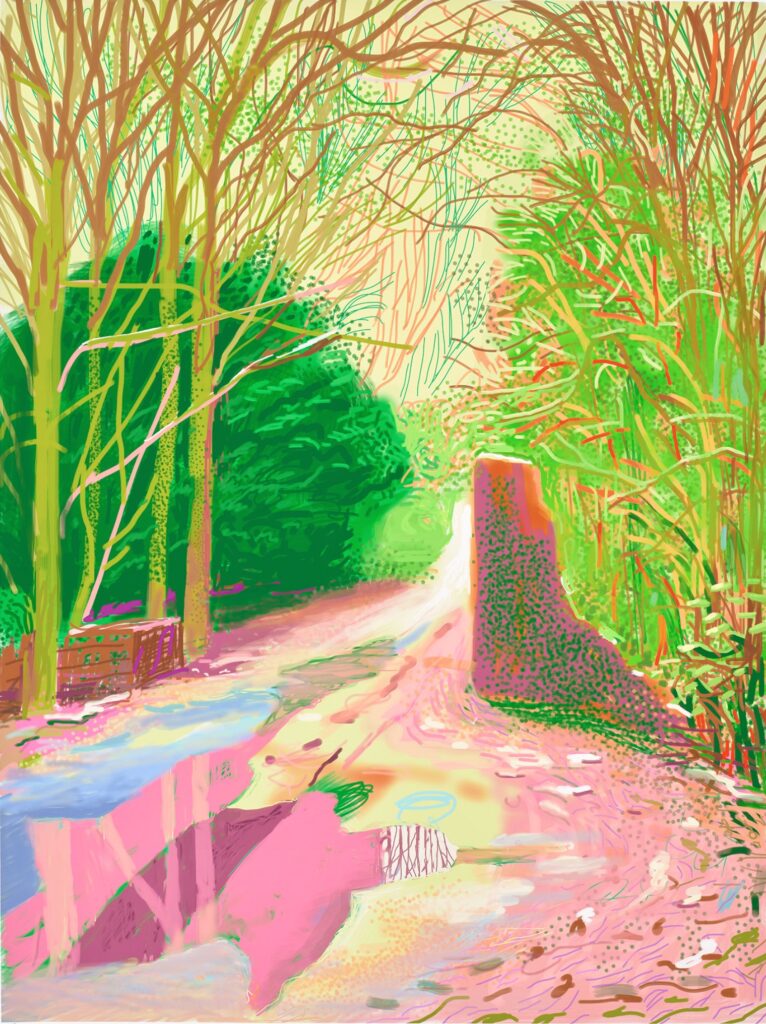
Digital and iPad works. A newer category specific to his later career. Hockney was an early, prolific adopter of digital drawing, and works in this category, including large printed versions of iPad drawings, have a shorter trading history and a less established secondary market than his paintings, drawings or traditional prints. Results here aren’t directly comparable to the painting market.
Anyone assessing “how the market is doing” needs to be clear which of these four they’re actually looking at. A record result in one segment says very little about the other three.
The Foundation, the archive, and what is and isn’t publicly known
The David Hockney Foundation isn’t a new creation of the past five weeks. It comprises two charitable entities established by the artist in 2008: The David Hockney Foundation (U.K.) Limited (registered Charity 1127262) and The David Hockney Foundation, Inc. (a US 501(c)(3) private operating foundation), set up to advance appreciation of his work through exhibition, preservation and publication. The Foundation holds more than 8,000 works, including editioned prints, paintings, drawings, sketchbooks, and archival material, and regularly lends them to exhibitions worldwide. A catalogue raisonné project, first publicly reported in May 2024, is underway alongside David Hockney Inc., involving Hockney himself, Foundation trustees and outside researchers; a first volume covering his paintings has been reported as intended for online publication, though an exact completion date has not been independently confirmed through the Foundation’s own channels. For authentication questions, collectors are best served by consulting the relevant foundation, the catalogue raisonné project once published, and qualified independent specialists, rather than relying on any single source or procedure.
What isn’t publicly confirmed is any statement from the Foundation about how, or whether, it intends to manage the pace at which future work from the studio or archive enters the market. The position is not publicly confirmed, and anyone considering an acquisition should treat it as such rather than assume a policy either way.
Recent gallery relationships are on the public record. Annely Juda Fine Art in London showed new paintings, including works from his “Moon Room” series, from November 2025 to February 2026, the gallery’s inaugural show in its new Hanover Square space. Pace Gallery marked his death with a tribute from founder Arne Glimcher. Pace Gallery and Annely Juda Fine Art remain prominent documented points of contact in Hockney’s recent exhibition history, although no exclusive posthumous representation arrangement has been publicly confirmed for either, and neither should be read as a complete account of who is connected to his work or estate.
Institutional standing, in view
Institutional attention is a separate question from price, but it shapes long-term demand, and Hockney’s standing going into 2026 was exceptionally strong. His largest retrospective to date, “David Hockney 25,” took over the entire Fondation Louis Vuitton building in Paris from April to August 2025, featuring more than 400 works curated with his direct involvement. In London, his first exhibition at the Serpentine, “A Year in Normandie and Some Other Thoughts about Painting,” opened in March 2026 and runs through August. Tate confirmed in March 2026 that it will mark what would have been his 90th birthday with “David Hockney,” a seven-decade retrospective at Tate Britain from 7 October 2027 to 20 February 2028, featuring more than 200 works across painting, drawing, printmaking, photography and digital media. None of this was arranged because of his death; the Tate Britain exhibition was already in motion, which says something about the institutional support his work carries into this next phase.
What this does, and does not, tell a collector
It’s tempting to treat a death as a signal that prices will rise, since supply is now fixed. History doesn’t support that as a reliable rule. Markets can also cool, particularly once the promotion and steady output that came with a living, exhibiting artist stops. Pricing often becomes more selective rather than uniformly stronger, rewarding the strongest, best-documented examples and leaving weaker pieces behind. Scarcity is real. On its own, it guarantees nothing.
For Hockney, an unusually strong institutional programme, a catalogue raisonné project already underway, and an established Foundation add up to a favourable starting position compared with many artists at this stage. That isn’t a prediction. What happens next depends on decisions not yet made public and the ordinary unpredictability of taste.
The practical takeaway
A collector thinking about Hockney’s market is better served by asking which of the four segments above a work sits in, what its documented history and condition are, and what independent evidence supports its value, than by reasoning from the fact of his death alone. That discipline, judging each work on its own evidence rather than a general narrative, holds regardless of which artist or market moment a collector is looking at.
For a private discussion about collecting David Hockney or assessing works within an existing collection, request an introduction to Zurani.
This article discusses David Hockney’s public market only. It does not describe, imply, or reference any transaction, holding, or advisory engagement involving Zurani, and should not be read as such.