Investing in art feels different from many traditional forms of investing. It is personal, emotional and often difficult to read from the outside, particularly for collectors entering the market for the first time.
A painting, sculpture or work on paper may attract you because it reflects your taste, culture or sense of identity. At the same time, you may want to understand whether it can hold value, appreciate over time and support a wider wealth strategy.
Art investment is the process of acquiring artwork with a considered view of quality, value and long-term demand. It is not about chasing quick returns, following short-lived trends or buying solely because a name appears familiar.
For many collectors, art sits at the meeting point of passion, capital and legacy. It can bring personal enjoyment while also forming part of a broader approach to wealth preservation, family planning and cultural stewardship.
However, confidence in this market rarely comes from instinct alone. It comes from research, careful selection, due diligence and the right advisory support. This guide explains how to invest in art with greater clarity, from understanding value to making informed acquisition decisions.
Understanding art as an investment
Art can form a meaningful part of a wider portfolio, particularly when it is approached with patience and clear intent. Strong works may hold value, appreciate over time and support diversification, but art behaves differently from listed investments.
Unlike stocks or bonds, art is not traded on a transparent public exchange. Prices are shaped by specialist knowledge, private sales, auction results, gallery relationships and changing collector demand. As a result, the market can feel opaque, even for experienced investors.
Art is also illiquid. A work may take time to sell, and the right buyer may not appear exactly when you want to exit. This makes timing, quality and acquisition price especially important.
There are also practical factors to consider. Storage, insurance, conservation, documentation and transport all influence the ownership experience. These are not reasons to avoid art, but they do show why the asset requires careful management.
A considered collector understands that art investment is not only about financial return. It is also about cultural value, personal meaning and long-term legacy. When these elements are balanced properly, art can become a thoughtful part of a wider wealth strategy.

Knowing what gives art value
The value of an artwork is shaped by a range of connected factors. Some relate to the artist’s career, while others relate to the specific work being considered.
Artist reputation is usually a key starting point. Collectors may look at exhibition history, gallery representation, institutional interest, critical recognition and collector demand. These signals can help show whether an artist has a strong and sustained position within the market.
However, the individual artwork still needs close attention. Date, medium, size, subject, rarity and condition can all affect value. A major work from a recognised period may carry a different profile from a smaller or less characteristic piece.
Provenance is also important. This refers to the ownership history of the work, and it can support confidence when clearly documented. A strong provenance may include respected galleries, established collections or previous public exhibitions.
Condition can also influence value significantly. Damage, restoration, fading or poor storage may affect desirability, especially for works on paper or delicate materials. In some cases, condition concerns can change the investment case entirely.
This is why two similar-looking works can have very different market profiles. One may have stronger provenance, better condition or clearer demand, while the other may carry unresolved questions.
A serious buyer looks beyond surface appeal. They ask where the work sits within the artist’s practice, how it compares with similar examples and why it matters within the market.
Choosing between blue-chip and emerging artists
Many collectors consider both blue-chip and emerging artists when shaping a collection. Each route has its own opportunities, limitations and role within a wider strategy.
Blue-chip artists are established names with recognised market histories, institutional visibility and sustained collector demand. Their work may offer a clearer record of past pricing, which can make the market easier to assess.
This does not mean blue-chip art is without risk. Entry prices are often higher, and future growth may be more gradual. There may also be stronger competition for the best works, particularly those with desirable provenance and strong condition.
Emerging artists offer a different kind of opportunity. Their work may be more accessible, both financially and personally, while also allowing collectors to support artistic careers at an earlier stage.
The potential upside can be meaningful, but the uncertainty is higher. Emerging markets are less tested, and an artist’s long-term position may still be developing. Gallery support, institutional interest and critical momentum should therefore be reviewed carefully.
A thoughtful collection does not need to rely on one route only. Some collectors build a foundation around established artists, then add selected emerging names with care and conviction.
The right balance depends on your objectives, budget, time horizon and appetite for uncertainty. For many collectors, the strongest strategy is layered, combining recognised quality with informed discovery.

Why due diligence matters before you buy
Confidence in art investment comes from process, not impulse alone. A work may feel compelling, but the acquisition still needs careful review before you commit.
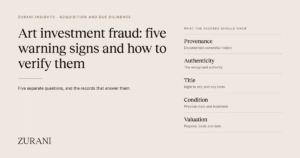
Provenance should be checked, as it helps confirm the history and legitimacy of the work. Clear ownership records can reduce uncertainty and support future resale value.
Authenticity is equally important. Depending on the artist, this may involve certificates, catalogue references, expert review, foundation records or gallery documentation. The level of evidence required will vary by artist and market segment.
A condition report can also provide valuable protection. It can identify damage, restoration, structural issues or material concerns that may not be visible at first glance.
Valuation should be considered alongside comparable sales, artist demand and current availability. The aim is not simply to ask whether a work is attractive, but whether the price is justified.
The acquisition route also matters. Buying through a gallery, auction house or private sale can create different costs, obligations and levels of transparency. Auction purchases, for example, may include buyer’s premium and fixed sale terms.
Ownership title should also be reviewed. A buyer needs confidence that the seller has the legal right to sell the work.
These steps may seem technical, but they are central to confident collecting. They help protect the buyer, support future planning and ensure decisions are based on more than emotion.
How an art advisor can support your investment journey
An art advisor helps bring structure to a market that can be difficult to navigate alone. Their role is to support decisions before, during and after acquisition.
At the beginning, advisory support can help define your collecting strategy. This may include budget, artistic focus, preferred regions, risk appetite and long-term objectives.
An advisor can then help source suitable works through galleries, auctions, private networks and trusted market relationships. Access matters, particularly when strong works are not widely available.
They can also assess whether a work fits your wider collection. A good acquisition should make sense visually, culturally and financially, rather than standing alone as an isolated purchase.
During the buying process, an advisor can support valuation, negotiation and due diligence. This can help you understand whether the opportunity is fairly priced and properly documented.
After purchase, advisory support can continue through collection management. Documentation, insurance, conservation, storage, shipping and future valuation all require careful attention.
For private clients, family offices and international collectors, the planning can become even broader. A collection may eventually involve succession, gifting, estate planning or future sale strategy.
Zurani supports collectors across the UAE and selected international markets, helping clients build collections with clarity and care. Our role is not to remove personal taste from the process. Instead, we help place personal taste within a stronger strategic framework.
Building confidence before your next acquisition
Art investment is not about chasing trends or moving quickly because the market feels exciting. It is about building knowledge, asking better questions and surrounding each decision with the right expertise.
The most rewarding collections often grow over time. They reflect personal connection, but they are also supported by research, discipline and a clear view of quality.
Before making your next acquisition, consider the wider picture. Ask what the work adds, how it has been valued and what risks need to be reviewed before you proceed.
With the right process, art can become more than an asset. It can become part of a personal, family or cultural legacy, shaped with care across generations.
To discuss your next acquisition, contact us at +971 58 593 5523, email us at contact@zurani.com, or visit our website at www.zurani.com.