Most art fraud does not involve an obviously fake painting. The cases that reach the courts tend to turn on something less visible: a provenance that reads well but cannot be evidenced, an ownership interest sold twice, a payment routed to an account nobody checked, or an investment structure in which the promised return mattered more than the work. For a collector, a family office or an adviser reviewing an acquisition, the question worth asking is whether the ordinary checks have been done, and whether anyone has been discouraged from doing them.
What are the main warning signs of art investment fraud?
Five signs recur in the documented cases: a provenance that cannot be evidenced entry by entry; an attribution that rests on assertion rather than the recognised authority for that artist; ownership that is unclear, contested, or already sold or pledged elsewhere; a transaction built around promised returns, buybacks or guaranteed income rather than the work; and pressure around payment, custody or timing. Each corresponds to a check a careful buyer would normally make. Many documented frauds exploit gaps in one or more of those checks.
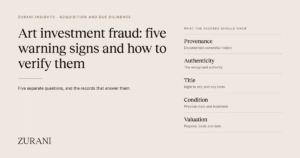
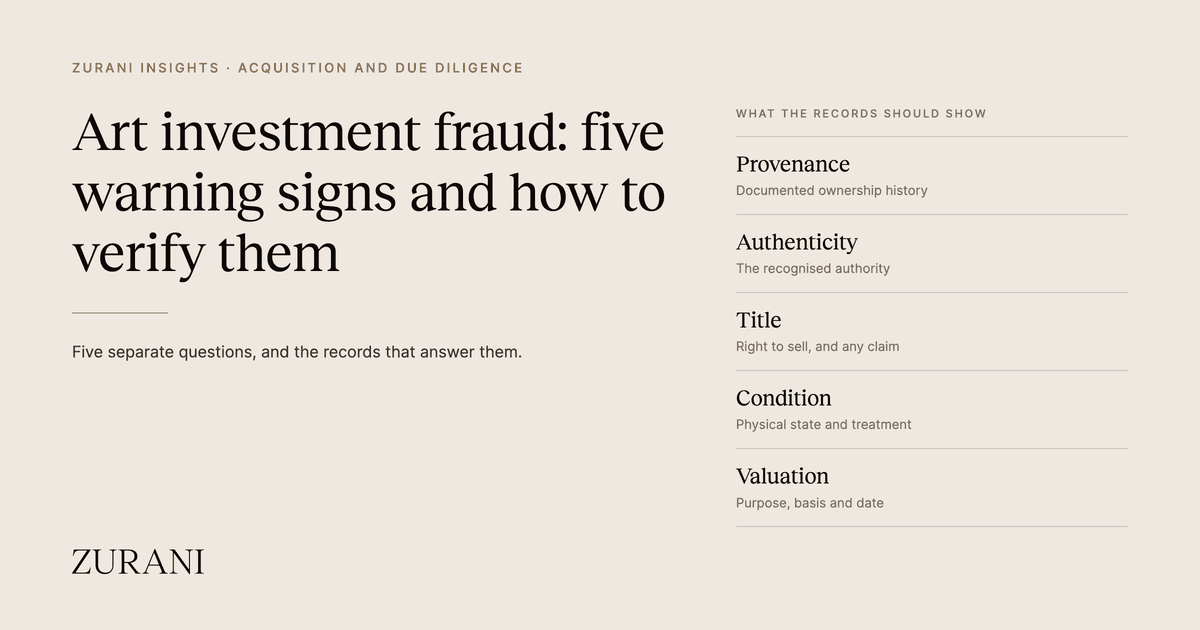
Five separate questions
A distinction first, because several of the cases below turned on one answer being allowed to stand in for another. Provenance is the documented ownership history of a work. Authenticity is an assessment of who made it, supported by appropriate scholarship and expertise. Title is whether the seller has the legal right to sell and whether anyone else has a claim. Condition is the physical state of the object and its treatment history. Valuation is an opinion of worth for a stated purpose on a stated date. A two-page provenance does not prove authenticity. An authentication letter says nothing about title. A high valuation does not mean the seller owns the work.
1. A provenance that reads well but cannot be evidenced
The history names collections, galleries and sales, sometimes going back decades, and there is little or nothing behind the names: no invoices, no exhibition records, no correspondence, and often a story explaining why the documents are unavailable. Discretion is normal in this market. A total absence of evidence is not.
The Knoedler case remains the clearest illustration. According to the record of her guilty plea in the US District Court for the Southern District of New York, between 1994 and 2009 the dealer Glafira Rosales sold more than 60 fake works, presented as by Rothko, Pollock, de Kooning, Motherwell and others, to two Manhattan galleries for approximately US$33.2 million. The galleries went on to sell them to buyers for more than US$80 million. The plea record states that the provenance Rosales supplied for the works was false.
Verify each entry in the chain rather than the chain as a whole. An auction sale should appear in a catalogue and a price record; a gallery sale should have an invoice; an exhibition should appear in a catalogue or an institutional record. Where an entry has no evidence, treat it as a claim, and decide knowingly whether to accept that gap before completion. A long history with an unexplained silence deserves more attention than a shorter one that is fully documented. The Investment Guide puts it the same way: provenance gaps should be resolved, or explicitly accepted as a known limitation, before a purchase completes.
2. Authentication that depends on vague authority
A certificate, a letter or a confident verbal assurance from someone whose standing to give it is unclear. Sometimes a scientific test is offered in place of scholarly opinion, or the reverse, as though either alone were conclusive.
Authentication is not one thing. For many artists there is a recognised authority: a catalogue raisonné, a foundation, an estate, or an established specialist whose opinion the market accepts. For others there is none. The Knoedler case illustrates why attribution should be tested against the appropriate scholarship, provenance research and, where proportionate, scientific analysis, which is the approach the Responsible Art Market toolkit sets out.
Establish who the recognised authority for this artist actually is, whether the work appears in the catalogue raisonné or the foundation’s records, and, for a significant purchase, whether independent technical analysis is proportionate. Where no recognised authority exists, that limitation should be recorded and considered in the acquisition decision. Resistance to an appropriate authentication inquiry should prompt further scrutiny.
3. Ownership that is unclear, or has already been sold
A seller who is not the owner and cannot show authority to sell. A work in storage or on consignment with more than one party claiming an interest. An offer of a share in a work rather than the work itself, with no register of who owns what.
The case of the dealer Inigo Philbrick shows how far this can go in a sophisticated market. According to the US Attorney’s Office for the Southern District of New York, he concealed ownership interests, sold overlapping and fraudulent fractional interests in high-value contemporary works, used works as loan collateral without the knowledge of some co-owners, and produced fabricated documents to support his representations. He was sentenced in May 2022 to seven years and ordered to forfeit US$86.7 million. The case shows why ownership interests and encumbrances should be checked independently of the seller’s own records.
Confirm the identity of the seller and its authority to sell, the chain of title from the last documented owner, and whether the work is subject to any loan, consignment agreement, lien or co-ownership. For a shared interest, insist on a written register of every holder and every charge, kept by someone other than the promoter. Title is a legal question. Where it is unclear, or the sum is significant, it belongs with legal counsel before completion.
4. A structure built around returns rather than the work
An offer to buy art, or a share in art, with a promised monthly income, a guaranteed buyback, a fixed return, or a resale profit described as if it had already happened. In these structures, the financial promise can become more prominent than the underlying work.
In July 2026 the Seoul Central District Court sentenced the head of a Seoul gallery to 18 years in prison. According to reports of the ruling in the Korea JoongAng Daily and SBS News, the scheme ran from 2016 to 2025, took more than 100 billion won (roughly US$65 to 70 million) from 981 investors, and promised monthly returns and principal repayment on artworks that investors were told would be exhibited or rented out. The court found that some of the works did not physically exist or had already been sold to other buyers, and that money from new investors was used to pay earlier ones. Appeal status had not been reported at the time of writing.
Owning an artwork does not itself create a guaranteed return. Where an art-related structure promises fixed income, guaranteed returns or a buyback, those financial promises require scrutiny in their own right. The SEC’s general investment-fraud guidance, which is relevant to investment-style art schemes as well as other offers, lists guaranteed returns, “risk-free” offers and pressure to act quickly among its red flags. Ask what you would actually own, where it is, who holds it, whether it can be inspected, and what happens if you wish to sell. When the answer about the return is more detailed than the answer about the work, that imbalance is the warning.
5. Pressure around payment, custody or timing
A request to pay quickly, to a personal or third-party account, in instalments that keep each payment below a threshold, or before the work can be inspected. A reluctance to release the work for a condition report. A delivery address that has nothing to do with the buyer. Each can have an innocent explanation; together they form the pattern regulators describe. In the UK, the anti-money-laundering regime applies to art-market participants involved in transactions, or linked transactions, of at least 10,000 euros, and HMRC’s guidance specifically identifies deliberately split payments and unusual delivery or transaction arrangements as risk indicators.
The art market also supplies real deadlines: a fair closes, an auction ends, another buyer is said to be waiting. A legitimate deadline may exist, but it does not make due diligence optional. Make sure payment goes to the entity named on the invoice, that the invoice describes the work, the price and the parties accurately, that custody and insurance are agreed in writing from the moment risk passes, and that every material representation made during the sale is recorded before completion. Representations that exist only in conversation are hard to rely on later.
How to verify: a practical framework
The Responsible Art Market Initiative, an industry-supported not-for-profit body, organises transaction due diligence into three areas: the parties, the artwork and the transaction. The approach is proportionate: a modest secondary-market purchase with a clean record needs less than a major work with gaps. These are the questions that most often expose a problem.
| Question | Who can answer it | What evidence looks like |
|---|---|---|
| Who is the seller, and do they have authority to sell? | Seller; their lawyer; company registry | Identity documents; corporate records; written authority where an agent acts |
| Is title clear of loans, consignments, liens or co-owners? | Seller; legal counsel; storage facility; any lender | Sale agreement with a warranty of title; consignment and storage records; financing or security documentation where relevant; legal review |
| Does each provenance entry have a document behind it? | Seller; previous owners; auction houses; archives | Invoices; catalogues; exhibition records; correspondence |
| Has the work been reported lost, stolen or claimed? | Recognised loss and claims databases; legal counsel | Recognised loss or claims database search or certificate |
| Who is the recognised authority for this artist, and what do they say? | Catalogue raisonné compiler; foundation; established specialist | Catalogue entry; written opinion; technical analysis where proportionate |
| What is the condition, and what has been done to the work? | Independent conservator | Condition report; treatment history; images including the reverse |
| What is the work worth for this purpose, now? | Appraiser working to a stated purpose and date | Valuation report with comparables |
| Where is the work, who holds it, and can it be inspected? | Seller; storage facility; shipper | Location confirmation; inspection; insurance in force |
| How will payment be made, to whom, and against what? | Seller; your bank; legal counsel | Invoice in the seller’s name; escrow or staged payment where appropriate |
| What has been represented, and is it in writing? | Seller | Sale agreement recording condition, provenance, authenticity and title warranties |
The answers should come from sources other than the person selling wherever possible. A seller’s own certificate, valuation and provenance summary are a starting point, not verification. Title, contract terms, warranties and what can be enforced if something proves wrong are legal matters, and this article is not legal advice; a significant acquisition is worth a lawyer’s review of the sale agreement before completion.
What a well-documented transaction tends to allow
A well-documented transaction makes verification possible. A seller with clear title and a documented history can usually accommodate a buyer’s conservator, a catalogue raisonné inquiry or a lawyer reading the agreement. Documents arrive without a story about why they cannot. The work can be seen. The price is explained by comparables rather than by a projected return. Payment goes to the named seller against a proper invoice. A seller who cannot satisfy every check is not therefore acting in bad faith; gaps are common, and the point is to know what they are. These steps cannot eliminate fraud risk, but they reduce the number of assumptions a buyer is being asked to accept.
The practical takeaway
Read provenance entry by entry and treat undocumented entries as claims. Go to the recognised authority for the artist rather than accepting a substitute, and record it where none exists. Confirm title independently of the seller, with legal counsel where it is unclear. Treat any guaranteed return or buyback as a separate financial promise that needs its own scrutiny. Refuse pressure on payment, custody or timing, and record every representation in writing before completion. Where questions arise about the provenance, condition, valuation or acquisition history of a work, they are best resolved before completion rather than discovered afterwards.
If a work you are considering raises questions around provenance, condition, valuation or acquisition history, the team can review the available evidence with you in confidence.
This article is general information for collectors and their advisers. It is not legal, tax or investment advice, and it does not describe any transaction or engagement involving Zurani. Matters of title, contract and enforcement should be taken to qualified legal counsel in the relevant jurisdiction.
Sources
- Korea JoongAng Daily, “Art gallery head who scammed investors out of 100 billion won given 18-year sentence”, 12 July 2026.
- SBS News (English), “CEO of ‘Art Tech’ Firm Sentenced to 18 Years for $72 Million Fraud”, 12 July 2026.
- United States Attorney’s Office, Southern District of New York, “Former Art Dealer Sentenced To 7 Years For $86 Million Fraud Scheme”, May 2022.
- United States Attorney’s Office, Southern District of New York, “Art Dealer Pleads Guilty In Manhattan Federal Court To $80 Million Fake Art Scam, Money Laundering”, 16 September 2013.
- Responsible Art Market Initiative, “Art Transaction Due Diligence Toolkit”.
- HM Revenue & Customs, “Understanding money laundering risks and taking action for art market participants”, updated 18 September 2025.
- US Securities and Exchange Commission, Investor.gov, “Red Flags of Investment Fraud Checklist”.
- Zurani, The Zurani Investment Guide 2026, Chapter 5 and Chapter 9.
Related reading on this site: The importance of provenance in artwork · What every collector should ask before acquiring a new work · Why catalogue raisonnés matter in art investment · Art appraisals and valuations · Art advisory.